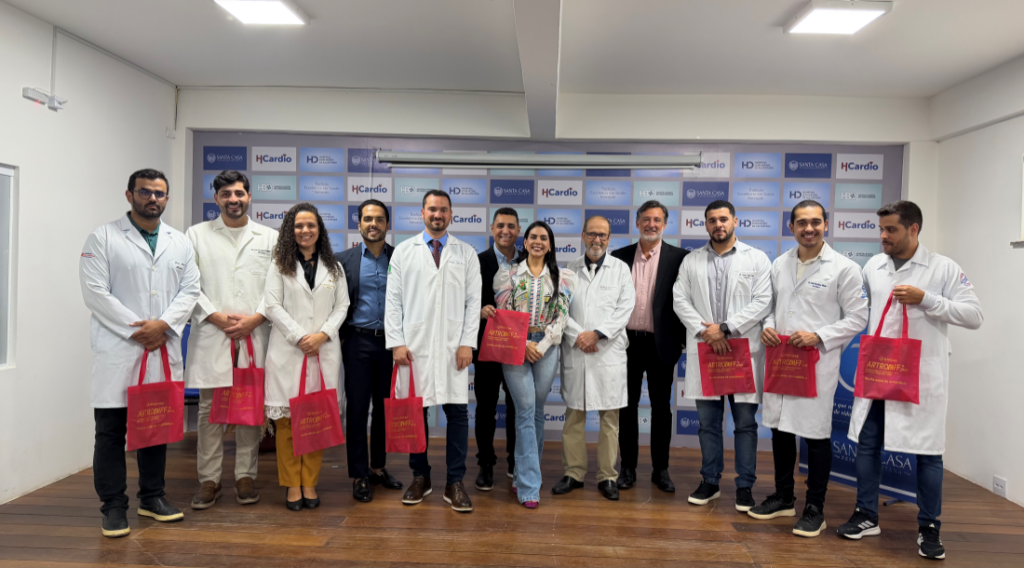


Medical simulation and virtual reality: how Santa Casa de Feira de Santana is transforming surgical training
The qualification of medical practice depends on a factor that is not always visible to patients, yet directly impacts the quality of care: how professionals are trained.
In Feira de Santana (BA), Santa Casa has taken a significant step by inaugurating a virtual laboratory dedicated to surgical training and medical education. This initiative marks the incorporation of simulation technologies and virtual reality into routine medical training, expanding learning possibilities within a controlled and safe environment.
Through the use of Meta Quest virtual reality headsets integrated with a simulation platform, physicians and residents now have access to a structure that enables technical training with greater repetition, predictability, and preparedness prior to real-world clinical practice.
What is medical simulation and why it is gaining ground
Medical simulation uses technologies such as virtual reality to recreate clinical scenarios in controlled environments. In practice, this allows procedures to be trained without direct exposure to clinical risk.
This model represents a significant evolution compared to the traditional format, in which practical learning occurs exclusively in real clinical settings. Key benefits include:
- Repetitive and standardized training
- The ability to make errors without patient impact
- Technical improvement prior to clinical practice
- Increased safety for both professionals and patients
More than a trend, this represents a shift in how technical knowledge is consolidated in medicine.
Santa Casa de Feira de Santana: innovation applied to medical training
With the implementation of the virtual laboratory, Santa Casa de Feira de Santana expands its role beyond patient care, strengthening its position in the training of healthcare professionals.
The structure is now integrated into the Medical Residency program and serves multiple specialties. Initially applied to orthopedics, the technology is also being used in fields such as cardiology and cardiovascular surgery, broadening the initiative’s impact.
The Supervisor of the Orthopedic Medical Residency Program, Dr. Denisval Cavalcanti, highlights that the virtual environment enables safer and more consistent training of surgical techniques, fostering technical development among professionals.
The program coordinator, Dr. Aderbal Freire, emphasizes that the primary beneficiary is the patient, as better-prepared professionals tend to deliver higher-quality care.
The role of the industry in advancing medical training
The advancement of healthcare depends on the integration of different stakeholders: institutions, professionals, and industry.
In this context, Diffucap participates in the initiative by donating the virtual reality headsets used in the laboratory, directly contributing to the implementation of the training infrastructure.
During the launch event, the company’s Vice President, Júlio Rocha, emphasized the importance of investing in healthcare technology, reinforcing the alignment between the company’s operations and initiatives that prioritize professional qualification and patient safety.
More than a one-time contribution, this type of involvement expands the role of the industry within the healthcare value chain, connecting innovation, training, and clinical practice.
Virtual reality in medicine: trend or new standard?
The use of virtual reality in medical training has moved beyond the experimental stage and is advancing as an expanding model. By enabling:
- Simulation of complex clinical scenarios
- More objective performance assessment
- Risk reduction in procedures
this technology is establishing itself as a strategic tool in medical education.
How simulation directly impacts the patient
At the center of any advancement in healthcare is the patient. The relationship is direct: better-prepared professionals tend to make more accurate decisions, perform procedures more safely, and reduce complications. Simulation contributes to:
- Greater technical precision
- Reduction of errors
- Improved clinical outcomes
- Increased patient safety
Better training means better care
The incorporation of simulation technologies into medical training represents a consistent advancement for the healthcare sector. By supporting initiatives such as that of Santa Casa de Feira de Santana, Diffucap positions itself in alignment with a movement that connects technology, professional qualification, and clinical responsibility. In a context where every decision directly impacts the patient, better preparation remains one of the most concrete ways to deliver better care.